Quorail
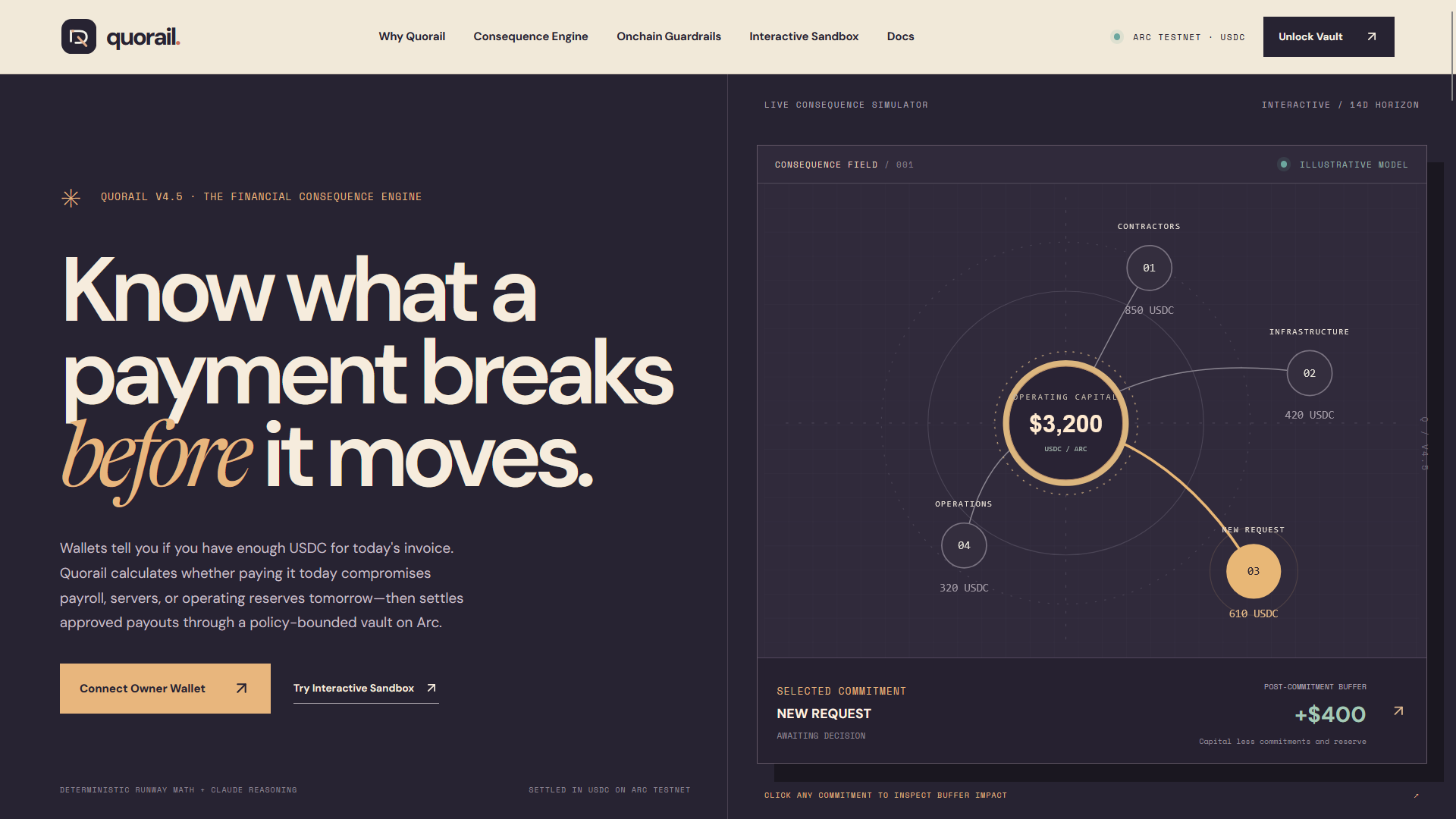
I built Quorail because a wallet balance doesn't tell the whole financial story.
Imagine a small business with $1,500 in its treasury. A $600 invoice arrives, and the payment looks affordable. But what if the business has $1,200 in upcoming commitments and needs to protect another $200 for emergencies?
That $1,500 balance suddenly tells a very different story.
This question became the foundation of Quorail: What if financial software could explain the consequences of a payment before the money moves?
I used AI-assisted development to turn that idea into an interactive treasury experience. Quorail combines Claude's financial reasoning with deterministic calculations and smart contract controls on Arc Testnet.
Building it meant solving two very different challenges. First, making complicated financial dependencies easy to understand through an interactive consequence map and cinematic interface. Second, ensuring that AI could recommend a decision without having unrestricted control over money.
The result is a system that can recommend paying, holding or escalating a transaction while enforcing independent spending restrictions.
I also built an interactive sandbox so anyone can explore financial scenarios without connecting a wallet.
Quorail is an experimental testnet project, but the bigger idea is simple: the next generation of financial tools should help us understand what money needs to do tomorrow, not just what we can spend today.
Tech stack
- ChatGPT (GPT-6)
- Cursor
- Nano Banana Pro
- GitHub Copilot
Links
Prompt
Build Quorail: The Financial Consequence Engine, an AI-powered treasury application for businesses managing USDC payments on Circle's Arc blockchain.

The problem: A business may have enough money to pay an invoice today but still risk missing payroll, infrastructure expenses, or other critical obligations tomorrow. Traditional financial dashboards show available balances without explaining the consequences of spending.

Build something fundamentally different: a treasury that evaluates what each financial decision changes.

Core requirements:

1. Develop a financial consequence engine that analyzes available USDC, upcoming obligations, payment deadlines, priorities, and protected reserves.
2. Integrate Anthropic Claude to evaluate structured financial information and recommend one of three decisions: PAY, HOLD, or ESCALATE, with a clear explanation.
3. Implement deterministic liquidity calculations and enforce spending policies independently of AI recommendations.
4. Create a Solidity smart contract on Arc Testnet that restricts payments using authorized recipients, transaction limits, daily spending limits, and owner-controlled permissions.
5. Build an interactive consequence simulator where users can model hypothetical payments and immediately understand their impact on future liquidity.
6. Maintain a decision ledger capturing the reasoning, financial context, and execution status of every evaluated payment.
7. Design a custom premium financial interface with cinematic scrolling, interactive visualizations, deliberate typography, and responsive layouts. Avoid generic AI dashboards and ordinary crypto templates.
8. Provide a visitor-friendly sandbox where anyone can explore illustrative scenarios without a wallet or private financial information.
9. Use Next.js, TypeScript, React, Claude, PostgreSQL, Solidity, and Arc Testnet USDC. Deploy the website through Vercel.

Design principle: The AI should explain financial consequences, but deterministic rules and smart contracts must control whether funds can move.

The result should feel like a new category of financial software: a system that does not simply show how much money exists, but reveals what a payment could put at risk.3 likes · 2 comments · 4 views
Comments (2)
Glad to see my friend here, Best builder on point
Good job man, this website looks great. Great way to budget and track your spending for teams. I may even look into using this myself. Great post, thank you for sharing and welcome to Prompted!!