Casto
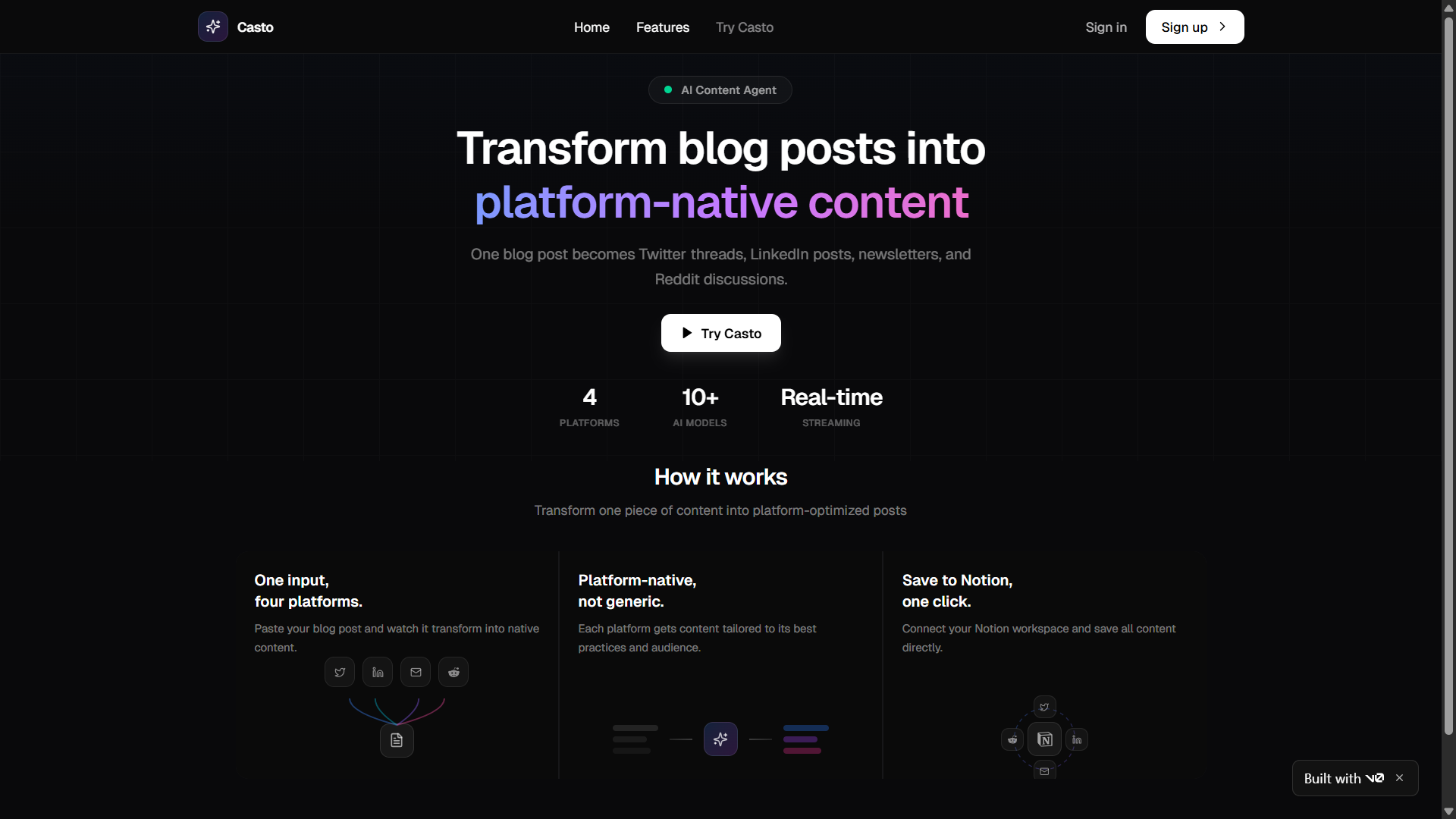
Casto was created by independent developer me to solve a common problem for content creators: adapting one article for several social platforms takes too much time.
Using v0 by Vercel, Raj built the entire application, including its interface, backend and database integration.
The distinguishing idea was to use four cooperating AI stages rather than one generic writing prompt.
Casto demonstrates how an independent developer can build a practical AI agent application using AI-assisted software development.
Tech stack
- Vercel
- Lovable
- Claude Code
Links
Prompt
PROJECT: CASTO — AI CONTENT REPURPOSING AGENT

Project Vision

Build a sophisticated, AI-powered content repurposing web application that transforms a single long-form article into multiple high-quality, platform-specific content formats.

The application should help independent creators, startup founders, marketers and businesses distribute their ideas across different platforms without repeatedly rewriting the same information.

Unlike ordinary AI writing tools, this platform should use a structured, multi-step AI agent workflow that analyzes the source content, creates specialized outputs, evaluates their quality and refines the results.

The product must be realistic for an independent developer to build using v0 by Vercel and modern AI APIs.

Create an original visual identity and production-quality user experience.

1. Premium Landing Page

Design a polished, dark-themed landing page with a striking editorial identity.

Use charcoal-black backgrounds, subtle violet accents, refined typography, clean card layouts and restrained motion.

Create a prominent headline:

"Transform One Idea Into Content for Every Platform."

Include an interactive preview demonstrating how a single blog post becomes an X thread, LinkedIn post, newsletter and Reddit discussion.

Add supporting sections explaining the AI workflow, available platforms, content quality evaluation and export features.

Provide prominent "Try Casto" and "Start Creating" actions.

Use purposeful Framer Motion interactions, responsive layouts and meaningful loading states.

Avoid excessive gradients and generic AI startup aesthetics.

2. Intelligent Content Input

Develop a clean content submission workspace.

Allow users to:

- Paste long-form articles.
- Enter short written ideas.
- Provide blog post text.
- Specify the intended audience.
- Select the original content's tone.
- Define the main message.
- Choose target distribution platforms.

Provide a large text editor supporting markdown formatting.

Display word count, character count and source-content validation.

Preserve paragraph structure and important information.

Allow users to save drafts and restore previous work.

Do not require a user to register before exploring a limited demonstration.

3. Four-Stage AI Agent Architecture

Develop a genuine agentic content-processing pipeline using the Vercel AI SDK.

The system must execute four clearly separated stages.

Agent 1: Analyze

The analysis agent examines the original content and identifies:

- Primary topic.
- Main argument.
- Key supporting points.
- Intended audience.
- Original tone.
- Important facts.
- Useful quotations.
- Potential engagement hooks.
- Content that should not be omitted.

Return structured JSON containing the analysis.

Preserve important factual claims without introducing unsupported information.

Agent 2: Write

The writing agent receives the structured analysis and creates tailored content for each selected platform.

Generate independent outputs rather than copying the same text into different formatting templates.

Apply platform-specific writing guidelines.

Agent 3: Evaluate

Develop an AI quality reviewer that evaluates every generated draft.

Assess clarity, fidelity to the original, relevance, readability, platform suitability and overall structure.

Identify overly generic wording, repetition, unsupported claims and weak introductions.

Return an evaluation report with actionable suggestions.

Agent 4: Refine

The refinement agent improves each draft using the evaluation results.

Strengthen introductions, remove unnecessary repetition, improve flow and preserve the intended message.

Retain the earlier draft for comparison.

Present the refined content to the user for final editing.

4. X Thread Generator

Create an AI writing workflow optimized for X.

Transform long-form content into a structured sequence of concise posts.

Each thread should contain:
- A strong opening hook.
- A clear central argument.
- Logical progression.
- Short, readable paragraphs.
- Important supporting information.
- A compelling conclusion.
- An optional call to action.

Respect the configured platform character limit.

Display thread posts as individual editable cards.

Allow users to rearrange, remove or regenerate individual posts.

Provide a copy-entire-thread option.

Avoid excessive hashtags, artificial engagement bait and unsupported claims.

5. LinkedIn Content Generator

Develop a dedicated LinkedIn writing workflow.

Generate professional content suitable for founders, professionals and businesses.

Emphasize clear storytelling, relevant insights, readable formatting and authentic personal voice.

Support educational posts, professional observations, company announcements and thought-leadership content.

Allow users to choose a writing style such as concise, analytical, conversational or storytelling-focused.

Display the generated content in a realistic platform preview.

Keep every paragraph editable.

6. Newsletter Generator

Create a workflow that transforms source articles into engaging email newsletters.

Generate:

- Suggested subject line.
- Optional preview text.
- Opening paragraph.
- Main content sections.
- Supporting explanations.
- Key takeaways.
- Closing message.
- Optional call to action.

Allow users to edit section headings and change content length.

Preserve the source article's important information.

Support Markdown and HTML export.

Avoid fabricated data, fictional testimonials or unsupported citations.

7. Reddit Discussion Generator

Build a platform-specific writing assistant for Reddit.

Focus on authentic, discussion-oriented content rather than promotional advertisements.

Generate a suitable title, relevant context, important observations and open-ended discussion questions.

Allow users to choose the intended community and provide its posting rules.

The AI should adapt tone and formatting to supplied community guidelines.

Do not invent community rules when they have not been provided or retrieved from reliable sources.

8. Real-Time Agent Execution Interface

Build an interactive processing visualization where users can observe progress through all four AI stages.

Display the current stage, completion status, elapsed processing time and concise descriptions of the agent's actions.

Show a chronological activity timeline.

Allow users to expand intermediate results such as extracted topics, draft summaries and quality assessments.

Do not expose or claim to display private model reasoning. Use explicit, application-generated progress summaries instead.

Implement graceful recovery from failed generation stages.

9. AI Model Selection

Integrate Vercel AI Gateway to support available language models from multiple providers.

Offer a model-selection panel where users can choose supported models according to available capabilities, cost and performance characteristics.

Keep the architecture provider-independent.

Allow different models to be assigned to analysis, writing, evaluation and refinement stages.

Provide sensible default settings so beginners do not need to configure models manually.

Display usage information and estimated generation costs when available.

10. Content Quality Dashboard

Create a quality assessment panel for every generated output.

Display structured feedback for:

- Clarity.
- Readability.
- Factual consistency.
- Audience relevance.
- Platform suitability.
- Originality of expression.
- Formatting quality.

Use a transparent scoring rubric.

Highlight important weaknesses and show proposed improvements.

Do not imply that an AI-generated score objectively guarantees engagement or content success.

11. Content Workspace

Design a three-panel creation interface.

Left: Original source article and generation settings.

Center: Generated platform-specific content.

Right: Agent progress, quality evaluation and editing tools.

Allow users to switch between X, LinkedIn, newsletters and Reddit without losing generated work.

Use a compact, efficient layout suitable for professional content production.

Include actions for regeneration, revision comparison, copying and saving.

12. Personal Content Library

Build a secure dashboard where users can organize generated content.

Each project should contain:

- Project title.
- Source material.
- Selected platforms.
- Generated drafts.
- Refined versions.
- AI model configuration.
- Creation timestamp.
- Project status.

Allow users to search, rename, duplicate and delete projects.

Support filtering by platform and date.

Implement version history for previous drafts.

13. Notion Integration

Add an authenticated Notion integration.

Allow users to connect a Notion workspace through an authorized integration process.

Provide controls for selecting an appropriate destination page or database.

Export selected generated content with headings, formatting and platform labels.

Handle failed exports and permission errors gracefully.

Never send content to Notion without the user's explicit action.

14. Content Performance Tracking

Build a lightweight analytics dashboard where creators can record how their published content performs.

Support manually entered metrics including impressions, likes, replies, shares, clicks and engagement rates.

Provide optional official platform API integrations where permitted.

Use line charts and comparison tables to display performance trends.

Keep manually entered figures clearly distinguished from verified API data.

Calculate derived metrics consistently.

15. AI Performance Insights

Introduce an analytics assistant that examines available historical performance information.

Identify recurring patterns in topics, writing formats, hooks and publishing approaches.

Generate practical suggestions for future content.

Distinguish correlations from proven causes.

Avoid claiming that specific generated content will become viral.

Allow creators to use previous successful posts as style references for future drafts.

16. Secure Authentication

Implement user registration and login using Supabase Auth.

Create private workspaces for each account.

Use PostgreSQL to store projects, content versions, generation records and analytics.

Apply Row Level Security policies.

Protect API credentials and integration tokens using secure server-side storage.

Allow users to delete their content and account data.

17. Technical Architecture

Use v0 by Vercel as the AI-assisted development environment.

Build the frontend using Next.js, React, TypeScript and Tailwind CSS.

Use Framer Motion for refined interface animations.

Implement the AI pipeline using Vercel AI SDK and Vercel AI Gateway.

Use Supabase for authentication, database persistence and secure server-side operations.

Create modular services for content analysis, generation, evaluation and refinement.

Use Zod for structured AI response validation.

Implement streaming interfaces, appropriate processing timeouts, retries and rate limiting.

Host the application on Vercel.

All model API keys must remain on the server.

18. Database Architecture

Create structured database tables for:

- User profiles.
- Content projects.
- Original source articles.
- Generation jobs.
- Platform-specific drafts.
- AI evaluation results.
- Revision history.
- Notion connections.
- Content performance records.

Associate all private records with authenticated users.

Store generation states so interrupted operations can be investigated or retried.

19. Visual Design

Create an original dark editorial design system.

Use near-black backgrounds, subtle purple highlights, compact data panels, crisp typography and purposeful animations.

Make the generation process feel like an intelligent creative workspace.

Avoid cluttered dashboards and overwhelming decorative effects.

Prioritize the original article, generated content and AI evaluation results.

Provide excellent responsiveness and accessible navigation.

20. Testing and Quality Assurance

Test the full content pipeline using different article lengths, writing styles and topics.
Verify that generated platform content remains faithful to the source.

Ensure refinement does not introduce unsupported claims.

Test content-saving functionality, authentication, database permissions and Notion exports.

Verify character limits, streaming failures and incomplete generation recovery.

Provide clear error messages when an AI provider is unavailable.

Final Deliverables

Deliver a working AI content repurposing platform containing:

- Premium landing page.
- Content input workspace.
- Four-stage AI agent workflow.
- X thread generator.
- LinkedIn content generator.
- Newsletter generator.
- Reddit discussion generator.
- Live processing visualization.
- AI quality evaluation.
- Model selection.
- Content library.
- Notion integration.
- Engagement analytics.
- Secure authentication.

Include clean source code, environment configuration, database migrations, deployment instructions and a comprehensive README.

Core principle: Create once. Adapt intelligently. Publish everywhere.
1 view