Wanderscout
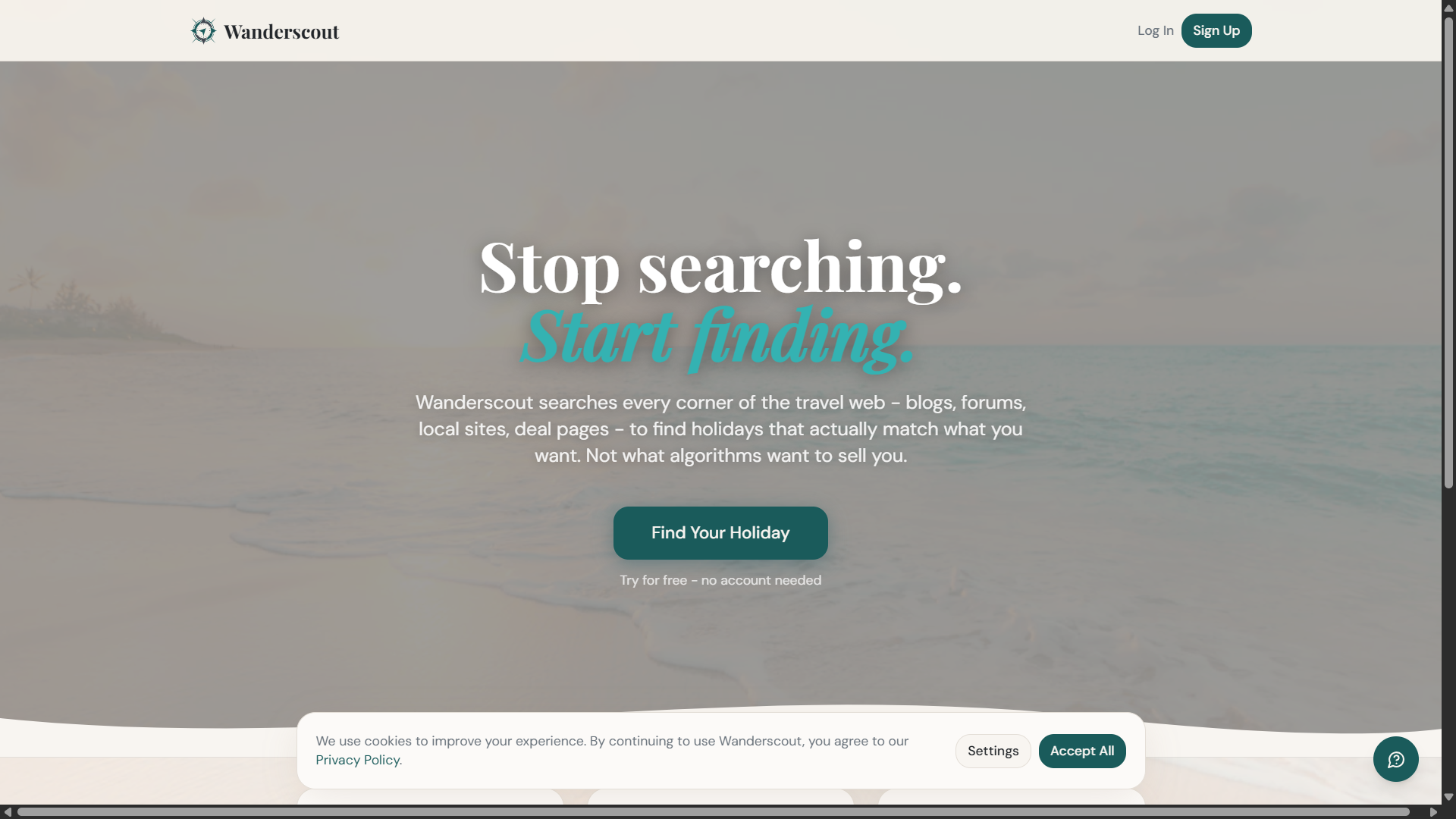
WanderScout was created by Michael Zorez and his family in Sweden which we collaborated to build it all successfully
As parents of two young children, they repeatedly encountered the same problem when planning holidays: endless comparison websites, scattered reviews, uncertain prices and destinations that didn't meet their family's needs.
They decided to build something different.
Using Lovable for AI-assisted development and Claude for travel research, they created WanderScout, a website that starts with what travelers actually want and searches for destinations that match.
What began as a project built during evenings around their day jobs became an independent AI travel discovery platform.
The idea is simple: instead of spending hours searching through destinations, let AI help you find the ones worth considering.
Tech stack
- Claude
- Google AI Studio
- ElevenLabs
Links
Prompt
PROJECT: AI PERSONALIZED TRAVEL DISCOVERY ENGINE

Product Vision

Build a premium, AI-powered travel discovery web application that helps users find holiday destinations perfectly suited to their preferences, budgets, travel dates and personal requirements.

Most travel booking platforms assume users already know where they want to travel.

Create a fundamentally different experience.

Instead of beginning with a destination, the application should begin with the traveler's needs.

A user should be able to describe a holiday in natural language:

"We're a family of four looking for a peaceful beach destination in Europe during August. Our total budget is €2,500, including flights. We need a child-friendly hotel, warm weather and a short airport transfer."

The AI should understand those requirements, research relevant destinations and generate a carefully ranked shortlist.

Every recommendation must explain why it matches the user's preferences, what requirements remain unverified and where the supporting information originated.

The application should be achievable by a small independent development team using AI-assisted coding.

1. Premium Homepage

Design an elegant, editorial-style travel website with an immersive but restrained visual identity.

Use warm off-white backgrounds, deep teal accents, sophisticated typography and beautiful destination photography.

Create a powerful hero section featuring the headline:

"Stop Searching. Start Finding."

Include a concise explanation of how AI discovers trips based on individual requirements.

Place a prominent "Find Your Holiday" button beneath the headline.

Introduce subtle scrolling animations and attractive destination previews.

Add sections covering personalized discovery, requirement matching, real travel sources and intelligent trip comparisons.

Prioritize clarity, trust and visual quality over excessive animations.

2. Conversational Travel Search

Develop a natural-language travel search experience.

Allow users to describe their ideal holiday without completing long forms.

Support inputs such as:

"Find me a quiet beach holiday under €1,500."

"I want a romantic weekend with mountain views and a private balcony."

"Suggest affordable destinations with warm weather in December."

"Find family-friendly resorts with direct flights from London."

Integrate Anthropic Claude to interpret the user's request.

Extract structured preferences including:

- Departure location.
- Travel dates.
- Number of travelers.
- Total budget.
- Preferred climate.
- Accommodation requirements.
- Travel duration.
- Activities and interests.
- Accessibility needs.
- Essential restrictions.

Allow the user to review extracted requirements before searching.

Ask brief follow-up questions only when missing information would materially affect results.

3. Intelligent Destination Discovery

Build a destination research engine that combines structured travel data with relevant web research.

Search supported travel sources such as tourism boards, travel publications, local destination guides and official provider websites.

Identify destinations that plausibly satisfy the user's stated requirements.

Use AI to summarize information collected from reliable sources.

Preserve original source URLs, publication dates and retrieval timestamps.

Do not fabricate hotels, prices, destinations or attractions.

If a source cannot be verified, mark that information as unavailable.

4. Personal Requirement Matching

Develop an explainable ranking engine.

For each potential destination, evaluate how closely it matches the user's preferences.

Create a weighted scoring model that considers budget, travel convenience, accommodation availability, climate suitability, activities and mandatory requirements.

Allow users to assign different priorities to individual criteria.

Distinguish between confirmed matches, probable matches, missing information and clear mismatches.

Present an overall match score with a transparent breakdown.
Never describe a calculated preference score as an objective measure of travel quality.

5. AI Destination Recommendation Cards

Display results through visually compelling destination cards.

Each card should contain:

- Destination name and country.
- High-quality destination photograph.
- Explanation of why it was recommended.
- Overall match score.
- Estimated travel budget.
- Suitable travel period.
- Key experiences.
- Requirement checklist.
- Links to original sources.

Allow users to expand a card for more detailed information.

Include filtering and sorting controls.

Design the result cards to feel informative and premium rather than resembling generic hotel advertisements.

6. Live Flight Search Integration

Integrate Duffel API for supported flight-search functionality.

Allow users to specify departure airports, travel dates, passenger counts and cabin preferences.

Retrieve available flight offers from the provider.

Display departure times, arrival times, airlines, stops and quoted prices.

Clearly identify prices as live provider offers or estimates according to their origin.

Handle expired offers and currency conversion carefully.

Never invent flight availability when API results are missing.

Link users to authorized booking experiences rather than attempting unsupported transactions.

7. Accommodation Discovery

Integrate a supported hotel data provider.

Allow users to filter accommodation options by location, price, room configuration, amenities and suitability.

Support requirements such as:

- Family rooms.
- Swimming pools.
- Beach access.
- Accessible accommodation.
- Kitchen facilities.
- Flexible cancellation.
- Breakfast availability.

Show available evidence for each requested feature.

Distinguish verified property information from descriptive summaries.

Provide direct links to the original accommodation listings.

8. AI Travel Research Assistant

Create an intelligent conversational assistant that understands the current search results.

Allow users to ask:

"Which destination is cheapest overall?"

"Which location would be better for young children?"

"Show me alternatives with shorter flights."

"Why did this destination receive a lower match score?"

"Find something similar but less crowded."

The assistant should use structured destination data and retrieved sources to answer questions.

It should update recommendations when the user changes preferences.

Do not invent facts or change mandatory requirements without approval.

9. Interactive Destination Comparison

Build a side-by-side comparison interface.

Allow users to select two or three destinations and compare their characteristics.

Include travel costs, climate, journey duration, accommodation requirements, activities and source verification.

Use concise tables, checklists and visual indicators.

Highlight important differences without automatically declaring one destination universally superior.

Allow users to adjust their preference weights and immediately see how rankings change.

10. Intelligent Budget Planner

Create a travel budget estimation tool.

Allow users to define a total spending limit.

Break down estimated costs into:

- Flights.
- Accommodation.
- Local transportation.
- Food and dining.
- Activities.
- Optional extras.
- Contingency allowance.

Use verified provider prices where available.

Label assumptions and estimates.

Provide a visual budget allocation chart and warnings when projected costs exceed the user's limit.

Never imply that estimated prices are guaranteed.

11. Favorites and Saved Searches

Implement a personal travel dashboard.

Users should be able to save destinations, favorite recommendations and revisit previous searches.

Store search requirements separately from generated recommendations.

Allow users to duplicate a search and modify one preference without starting again.

Implement clear controls for renaming and deleting saved searches.

12. AI Travel Summary

Generate a concise travel research report for a selected destination.

Include:- Why the destination matches.
- Suggested travel dates.
- Approximate travel budget.
- Flight and accommodation findings.
- Main attractions.
- Possible drawbacks.
- Source references.
- Important uncertainties.

Offer an exportable PDF summary containing the research results and source links.

Use clean, readable typography suitable for sharing with travel companions.

13. User Authentication

Implement secure authentication using Supabase.

Allow optional guest searches so first-time visitors can experience the product without registering.

Require authentication only when a feature needs persistent storage or account-specific functionality.

Provide a profile page for managing saved trips, currency preferences and privacy settings.

14. Technical Architecture

Use Lovable as the primary AI-assisted development environment.

Build the frontend with React, TypeScript and Tailwind CSS.

Use Framer Motion for thoughtful interface transitions.

Use Supabase for authentication, PostgreSQL storage and secure backend functions.

Integrate Anthropic Claude API for natural-language search interpretation, research synthesis and personalized recommendations.

Use Duffel API for supported airline pricing.

Connect other travel data services only through documented, authorized APIs.

Keep API keys on the server.

Implement request validation, caching, rate limits and graceful error handling.

Use structured schemas for AI-generated outputs.

Separate deterministic matching calculations from AI explanations.

15. Travel Data Accuracy

Prioritize trustworthy recommendations.

Every factual destination claim should be traceable to a source.

Preserve timestamps for price and availability information.

Make it easy for users to open original provider websites.

Do not represent outdated prices as current.

Indicate when entry requirements, travel advisories or accommodation conditions require confirmation from official sources.

Avoid presenting AI recommendations as guaranteed bookings.

16. Premium Interface Design

Create a custom editorial identity that feels welcoming, sophisticated and modern.

Use atmospheric destination photography, refined typography, soft neutral backgrounds and controlled teal accents.

Keep the search experience prominent.

Use smooth transitions between preference gathering, research progress and destination results.

Display useful progress messages while searches are running.

Avoid generic chatbot layouts, heavy gradients and excessive visual decoration.

Make the website responsive across desktop, tablet and mobile devices.

17. MVP Development Plan

Build in practical stages.

Stage One: Premium landing page and conversational preference form.

Stage Two: Claude-powered preference extraction and structured destination recommendations.

Stage Three: Source-backed destination research and explainable matching scores.

Stage Four: Live flight search and supported accommodation discovery.

Stage Five: Saved searches, conversational refinement and destination comparison.

Stage Six: Budget planning and downloadable travel summaries.

Do not advertise unfinished integrations as operational.

18. Final Deliverables

Deliver a working web application containing:

- Premium homepage.
- Conversational travel search.
- AI preference extraction.
- Personalized destination recommendations.
- Explainable requirement matching.
- Source-backed travel research.
- Flight search integration.
- Accommodation discovery.
- Destination comparison.
- Saved searches.
- AI travel assistant.
- Budget planner.
- Shareable research summaries.

Include clean source code, environment configuration, database setup, secure API integrations and deployment instructions.

The final application should help users answer a question traditional booking websites often overlook:

"Where should I actually go?"

Build the application around one principle:

Find the holiday that fits the traveler, not the traveler that fits the advertisement.
1 view