Major Upgrade: ApexAgent OS 2.5 is Live with an All-New Editorial UI & Execution DAG
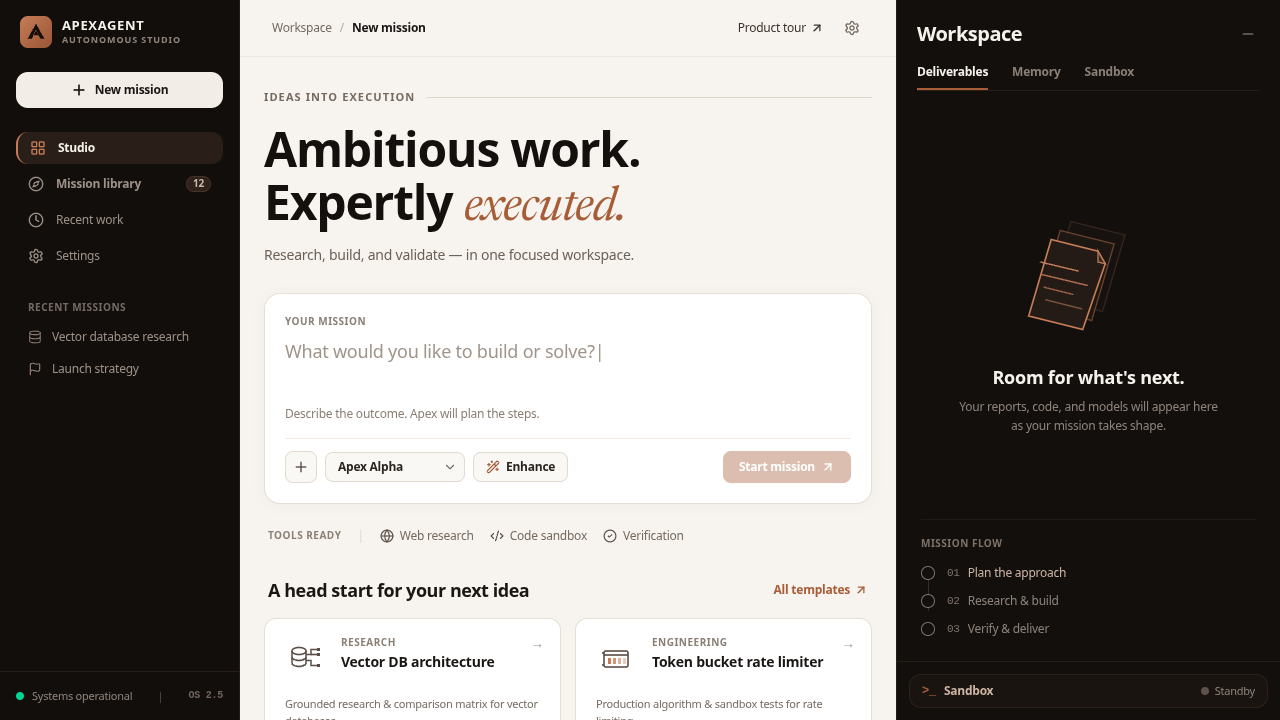
Introducing ApexAgent OS 2.5: Built for Thoughtful Execution We just rolled out a major design and architectural upgrade to ApexAgent OS, elevating it from a utility tool into a bespoke, high-performance workspace for autonomous engineering. What’s New: Editorial Dual-Tone UI: Redesigned from scratch with a warm paper canvas (#f7f4ef), crisp elevated cards, and deep smoked espresso sidebars accented by copper terracotta typography. We stripped away cluttered buttons and telemetry noise to give your thinking room to breathe. Interactive Execution DAG: Switch seamlessly between a chronological timeline feed and a real-time Execution Topology (DAG) to visualize milestone dependencies, agent reasoning traces, and sub-node tool calls. Dedicated Workspace Panel: Instant access to your live Deliverables, working Memory buffers, and an isolated JavaScript VM Sandbox with a dynamic 3-phase mission flow tracker. Production Presets & Prompt Enhancer: Four new engineering playbooks (Vector DBs, Rate Limiters, SaaS Economics, Launch Strategy) and one-click autonomous prompt expansion. Smarter, faster, and crafted for ambitious work.
Tech stack
- Gemini
Links
Prompt
Architect and validate an enterprise-grade distributed Token Bucket Rate Limiter for an AI API gateway handling 50,000 requests per second.

Execute this autonomous mission across five rigorous milestones:

1. System Architecture: Design a multi-region Redis-backed token bucket topology. Define exact mathematical refill intervals, burst tolerance ratios, and low-latency P99 SLA thresholds under high concurrency.
2. Sizing and Quantitative Math: Calculate the cluster memory footprint, Redis key expiration TTLs, and network bandwidth delta needed for 50M daily unique active API clients.
3. Code Implementation & VM Sandbox Verification: Write a production-ready TypeScript implementation of the token bucket algorithm with atomic Redis sliding window operations. Run isolated test fixtures in the code sandbox to simulate 1,000 concurrent requests, verifying zero race conditions and zero memory leaks.
4. Fault Tolerance & Chaos Playbook: Specify fallback strategies when Redis nodes fail or encounter network partitions, including client-side fallback quotas and graceful degradation modes.
5. Deliverables Forge: Synthesize a comprehensive executive technical architecture document in Markdown, complete with data schemas, benchmark metrics, and deployable TypeScript code. Store key architectural decisions in working memory for downstream integration.

Conduct self-critique audits ensuring full compliance with high-availability engineering best practices. Output all verified assets directly to workspace deliverables.